
Smith County Sheriff's Most Wanted Status
Want to know who the Smith County Sheriff's Department is hunting right now? You won't find out online. The sheriff's own page names the agency and lists its phone number, but it publishes no most-wanted list, no warrant database, and nothing like the "Warrant Wednesday" features some Kansas counties post. So any website showing faces and calling them Smith County's wanted list is working without an official source, and you should treat those names and photos with real doubt.
The direct route is a phone call. Dial 785-282-5180 and the sheriff's staff can explain the local process. The office sits at 217 South Jefferson Street in Smith Center, Kansas 66967. Wondering whether a warrant carries your own name? The district-court clerk or a private attorney can help with that too. Whatever you do, call first. Walking into a law-enforcement building because of something you read on a random web page is a gamble not worth taking.
What a Wanted Listing Should Show
Because Smith County publishes no local wanted list, nothing here can be presented as a current roster of fugitives. Still, when you run across a wanted notice from any official agency, a few fields tell you what it's really worth: the issuing agency, the named person, the alleged offense, and the date the notice was current.
| Field | Why it matters |
|---|---|
| Issuing agency | Shows who can confirm, update, or withdraw the notice. |
| Name and identifiers | Reduces mistaken identity; a name alone is insufficient. |
| Publication or update date | Shows how old the notice is and whether rechecking is urgent. |
| Warrant or charge | Describes the stated basis, not a conviction. |
| Photo and physical description | Identification aids that may be dated or incomplete. |
| Last known area | An investigative lead, not proof of current residence. |
| Caution instruction | Safety direction from the issuing agency. |
| Tip contact | The official channel for reporting information. |
Gaps in a listing should raise flags, not confidence. A private site might recycle an old booking photo, leave out whether a warrant was recalled, or mix up Smith County, Kansas with a same-named county in another state. That last mistake happens more than you'd think. Before trusting any entry, verify four things: which agency issued it, the jurisdiction, the date, and whether it still stands.
Use Smith County Wanted Information Safely
- Begin on the official sheriff page and confirm that any linked notice truly belongs to Smith County, Kansas.
- Record the issuing agency, publication date, warrant or case reference, and tip instructions.
- Call the issuing agency using contact information independently found on its official website, not a number copied from an aggregator.
- Provide a location, vehicle, time, or other factual observation. Do not investigate, confront, trespass, or publicize the person's location.
- If an arrest is later confirmed, use the Smith County booking-record routes for custody and booking context, then check the court record for disposition.
One caution is worth keeping in mind. A booking record proves only that someone was processed, not that every claim in the listing holds up. The charge logged at intake may not match the warrant's basis. A filed case can also shift as it moves through court. So picture four separate steps: the warrant, the arrest, the booking, and the court outcome. None of them tells the whole story alone.
Smith County Tips and Contacts
Smith County has no Crime Stoppers chapter, web tip form, or reward fund. So anonymity and payment are not promises anyone there can make. Start with the sheriff's published main number. The office will route you if another agency handles the matter.
217 South Jefferson Street
Smith Center, KS 66967
Phone: 785-282-5180
Fax: 785-282-5185
Emergency or immediate danger: 911
The county website points to an official sheriff Facebook page too. Posts there can carry notices and updates. It is not a full warrant feed, though. Treat anything you see as a dated message from the agency, then call to confirm what still stands.
Check a Smith County Warrant
A most-wanted list and a warrant check are two different things. The list is publicity, not a record. Most warrants never earn a spot on one. Smith County posts no verified local list and offers no public online warrant search, so any specific question needs a direct answer from the issuing office.
- Call the Smith County Sheriff's Department for the agency's current verification procedure.
- Contact the Smith County district-court clerk when the matter may be tied to a local case. Ask what identifying information and case details are needed.
- Search Kansas District Court public access for docket context, but do not treat a case entry as guaranteed proof that a warrant remains active.
- Use the Kansas Judicial Council warrant-disclosure forms when seeking disclosure of a warrant affidavit or sworn-testimony information through the court.
- Reconfirm with the originating agency because warrants may be served, recalled, sealed, corrected, or otherwise updated.
Judicial Council forms serve a narrow purpose. They request disclosure material tied to a warrant. They do not build an active-warrant list or confirm current status. Anyone worried about a warrant in their own name gets better results from a lawyer, who can weigh the specifics of the case.
County Warrants, State Lists, and Absconders
The KBI Most Wanted resource covers the whole state. Label it that way. A person on it is not necessarily wanted by Smith County, and a person missing from it can still have a local warrant out. Similarly, KDOC KASPER tracks people tied to state corrections, custody, supervision, or discharge. An absconder record is not the same thing as a county warrant.
Federal notices and U.S. Marshals pages deal with federal cases. Private warrant-search sites can mislead further, since they may hide when their data was pulled. Only the issuing agency can settle the question.
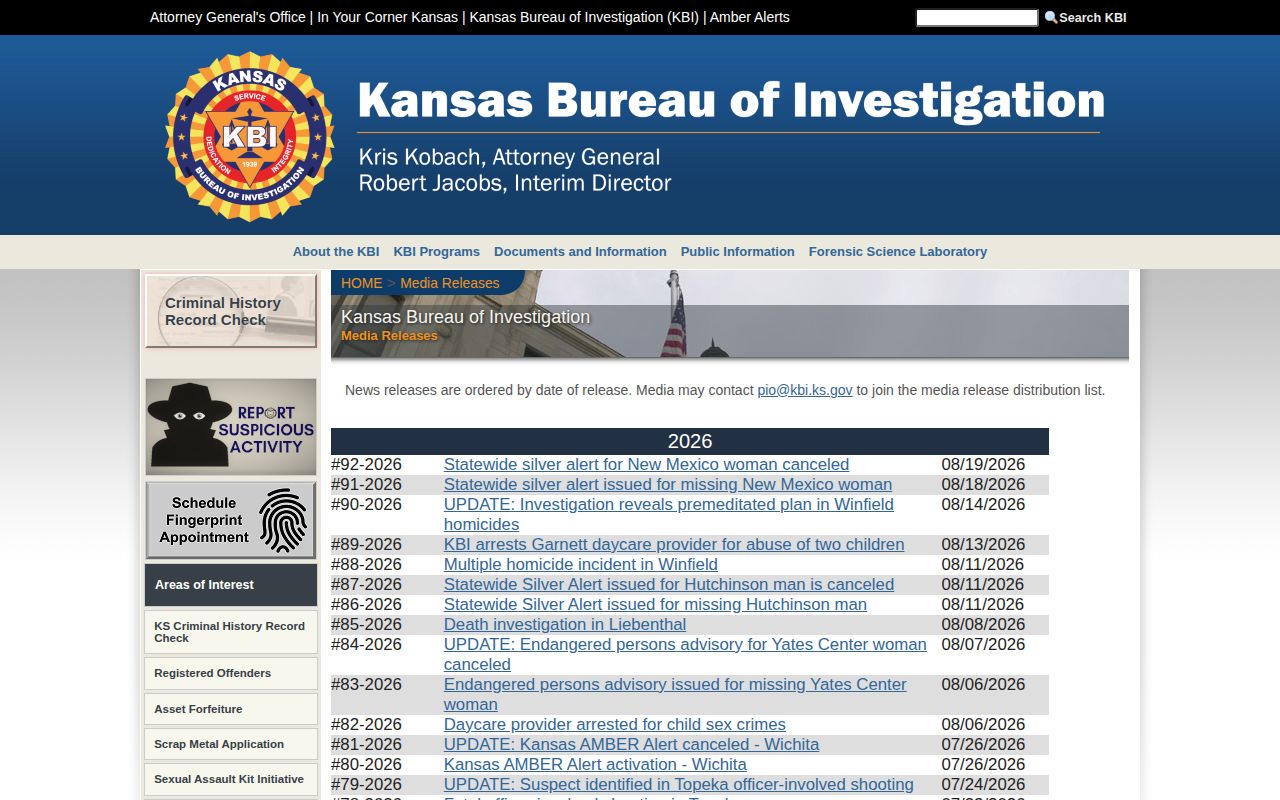
For statewide incident news, the KBI media-release page works as an official, dated fallback. The captured KBI release index shows what that source looks like.
Why Smith County Has a Verification Guide
The absence of a county list does not justify filling the space with private mugshot sites and guessed names. A verification guide fits the local reality better. Each official channel answers its own question: the sheriff explains current procedure, the court clerk handles case administration, the public docket adds context, and the Judicial Council forms open up supporting warrant material.
Dates matter for another reason. A warrant can be recalled after an appearance. A case can be sealed, or a name misidentified. What a warrant actually does is authorize a legal action under stated circumstances, and the case itself moves forward through the courts from there.
When Smith County Listings Change
Wanted and warrant information is time-sensitive. A court can recall a warrant, an agency can serve it, a judge can seal supporting material, or an office can correct an identity. A copied entry does not update itself. Preserve the source date, then seek a fresh answer from the issuing office.
An old booking image can be reused beside a newer allegation even though it came from a different event. Never infer a present warrant from an old mugshot. Match the case or warrant number, issuing agency, and current confirmation. Without those elements, treat a page only as an unverified lead.
After service, a person may enter Smith County Jail, be released under bond conditions, be transferred, or appear without a lengthy stay. With no online roster, VINE and the sheriff are same-day routes; KORA and the court docket form the durable trail.
Smith County Warrant Record Boundaries
Different records answer different questions. An affidavit supports the warrant. The docket tracks the case. The originating agency knows whether it has actually been executed. Judicial Council forms govern how much supporting material gets disclosed, while the clerk of court keeps the file itself. None of these adds up to a countywide wanted gallery the public can browse.
Even a confirmable case can have restricted paperwork behind it. Know the warrant or case number and the exact document you need before you ask. Vague name searches invite mistaken identities, and that risk climbs when birth dates and other identifiers are missing from the results.
Confirm the Current Warrant Date
Write down the date you confirmed a warrant, because its active status can shift right after a docket entry or a phone call.